The Other Bennet Sister: Episode 4 recap

I am happy to report that Mary has a new bonnet and it’s adorable!

Mary’s decided to push all thoughts of poetry and romance out of her mind and focus instead on really enjoying life in London. Good approach, Mary, there’s so much to enjoy!
She walks through the park, looking at everything and everyone and thinking that she can be anything she wants, in this land of anonymity. She’s determined to find something she can succeed at. It’s a bit sad when you stop and realise she’s in her 20s and doesn’t feel she’s found a single thing she can do well. But it’s good that she’s so upbeat about tackling that!
Chez Gardiner, she overhears her aunt and uncle commenting that she’s not the best governess (that’s putting it lightly). Her uncle astutely observes that his sister’s really done Mary a lot of harm, which is a shame, because besides being a governess, what else can she be but a companion to her mother?

(On a historical note: in a lot of well-off families with multiple daughters it was expected that one would remain unmarried to basically be her mother’s unpaid companion for life. Queen Victoria expected her youngest, Beatrice, to fill that role. Of course, she did not consult Beatrice about this, and when the girl had the temerity to find someone she wanted to marry, Victoria punished her by serving up the silent treatment. For MONTHS. Victoria was awful.)
The Gardiners continue to discuss how well Mary’s getting along with Tom and Anne, but agree she still seems a bit awkward and uncomfortable. They’re not wrong, and they’re not being mean here, they do seem genuinely concerned.
Mary rushes off before she can hear her aunt say she likes the girl’s curious and inquiring mind. Oh no, see, that’s something she’s good at! And she has facts, lots of facts, she’s good with the facts!
Out front, Mary runs into Tom, who asks how she’s getting on with the poetry. Mary is in NO MOOD and says she’s losing patience with it, because Wordsworth and Coleridge won’t come out and say what they really mean. I see she’s as allergic to subtlety as this show is.

Tom, for whatever reason, decides this is the moment to express condolences on the loss of Mary’s father. He tries to sympathise, saying it must be hard for her to be without the comfort of her sisters and mother and Mary does not laugh right in his face, which means she has far more self-control than I would have. She does, though, cut him off and says it’s a relief to be without her mother. And how! Tom will understand this someday, I’m sure. But at the moment, he’s not sure what to do with this rather unguarded moment and notes that she doesn’t seem to be herself.
As if this day needs it, Mary gets a scolding letter from her mother. Even in a letter Mrs B can’t help but drag her daughter. This is so tiresome. She drops that she’ll be spending the summer at Pemberley (guess Jane and Bingley got fed up fast) and she may require Mary to attend to her. No Mary! London! Parks and anonymity!

Oh, and she’s not sending for Mary to be a companion for her but for her new dog. Who the hell got this bitch a dog? What did the dog do to deserve that?
Mary re-applies herself to trying to find something she can be good at. She quickly discovers that painting is not it, though her work does have a certain post-Impressionist-Gauguin-ish quality to it. See, like Aunt Gardiner (who declares Mary’s painting ‘very neat’) I’m trying to find something nice to say here. How am I doing?

Aunt Gardiner tells her that Tom’s issued a rather mysterious invitation to Mary and the Gardiners. All they know is they’re to meet in the morning so he can ‘break through their rational reserve and move their hearts as well as their heads’. Sounds fun—will there be snacks?
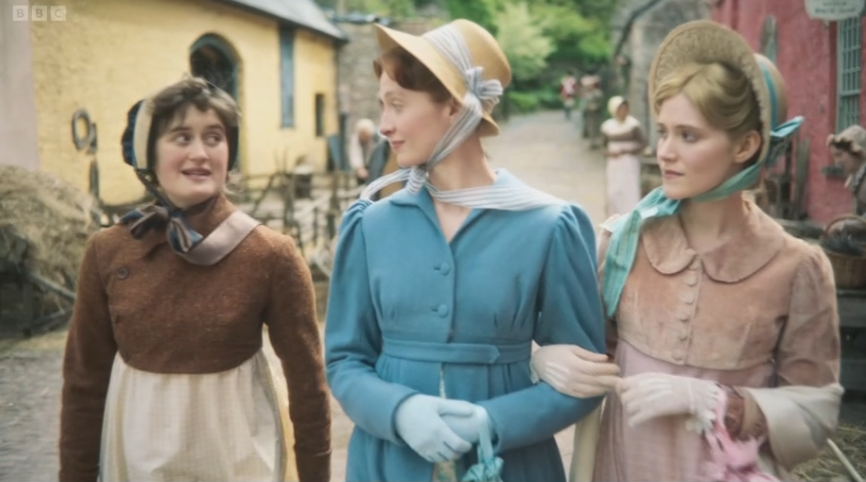
Mary tries to wriggle out, but Aunt Gardiner begs her to go, so she spends the evening choosing a bonnet. She, thank God, goes for the new one and not her unflattering old one. I’m impressed they managed to get her in a period-appropriate corset here, considering how sloppy they’ve been about a lot of the other costuming.
Tom has brought them to a hidden garden in the City of London, and no, Miss Baxter will not be joining them (Mr G asks). Tom explains that his almost-fiancée has ‘a variety of excuses that she skilfully deploys to avoid such events.’ Yeah, this seems like a happy couple. Mr G wishes he had some of those excuses to deploy, mostly because it’s raining.

Mrs G, however, will not let a bit of rain deter them. Tom helps Mary out of the carriage and I realise that, as nice as the bonnet is, it doesn’t really match anything she’s wearing. It almost does, but not quite. A part of me wonders if this is a deliberate character thing, that dressing herself is yet another thing she’s bad at, but she’s trying, and so everyone around her is being encouraging. Maybe that’s it.
Tom brings them into the garden, which is all stone columns and dripping wisteria and the saturation dialled up to about 11. Bridgerton-ization indeed. It’s pretty, but looks so oddly fake.

Tom sits everyone down on stone benches and tells them he wants Mary to learn to appreciate poetry by really experiencing it, as it’s meant to be. He recites Composed Upon Westminster Bridge. Mary seems interested, Mrs G is loving it, and her husband is hilariously baffled. Truly the face of: I came out in the rain for this? I could be having a nice cup of tea and some toasted cheese right now!

Mary gets more and more into it, even shedding a tear at the end of the poem. Thank God Tom didn’t roll up his sleeves or she would have really lost it.
The Gardiners engage in some cute, comfortable married-people banter and wander off to admire the wisteria. Mary takes her bonnet off, so now you know things are getting serious. Tom asks how she feels and she admits she has nothing to say. In a good way. She says her emotions feel feeble in the face of the poetry and he says he doesn’t believe she’s a stranger to strong emotions.

They have A Moment, and then she panics a bit and tells him she thinks she’ll have to leave London. He protests that she’s only just arrived and she gabbles about her mother needing her, and how he’ll be busy with Miss Baxter and everything. It’s clear she’s getting upset, which upsets him, because he’d hoped this would restore her spirits. She tells him it did, and she’ll never forget it.

Back at the Gardiners’, she tells her aunt and uncle she’ll be heading to Pemberley on the 18th, as her mother needs her. Her uncle slaps down his newspaper with all the fed-up outrage of an older sibling who knows his younger sister sucks, and he asks if his sister’s bored and therefore ruining Mary’s enjoyment of everything in life. Mary says she needs to go and Aunt Gardiner tells her sadly that they’ll all miss her a lot. After Mary leaves, the Gardiners exchange a troubled look.
Mary writes to her mother, promising to travel up to Pemberley. On her way to post it, she sees a copy of A Children’s Book of Verse in a bookshop window and goes to purchase it.
At the next lesson with the kids, she reads them The Old Woman Who Lived in a Shoe and sets them the assignment of writing and performing their own poem. The kids are stoked. Good lesson, Mary! George is going to do a poem about himself (and is relieved they’re done with the Glorious Revolution for the time being). Rebecca’s choosing between typhoid or frogs. Quite the difference there! Marianne will write about love. She seems a little young for that, but given her name, I can’t help but wonder if that’s a slight nod to Sense and Sensibility.
Mary is all in on the romantics now, and settles into bed to read Expostulation and Reply. This is quite the turnaround for her! I mean, the poem basically tells you to put books aside and LIVE!
Not to be all shallow, but she looks exceptionally beautiful here. What a glamour shot!

The kids perform their poems for Mary and their parents (Rebecca went with the frog, thank God, because she decided to bring a real, live frog as a prop and I don’t think we’d have wanted that with typhoid). She gets upset when she realises she forgot to use the frog in her performance, and Mary reassures her that props are cheap tricks that diminish the power of words. Poor Marianne quietly tucks away a model ship she was planning to use. Was that supposed to be funny? It wasn’t funny.

Later, Aunt Gardiner comes to Mary’s room to thank her for the kids’ poetry recital, and to reiterate that they’ll all miss her loads. Mary tries to say that London’s liveliness doesn’t suit her, which is manifestly untrue. I think Aunt G knows the real deal here and tells Mary that things change over time: people, situations…
Because she, like Wordsworth, talks around things a lot, she embarks on a rather tortured metaphor about hat shopping that basically boils down to: you don’t need to buy the first hat you find. Sometimes that hat’s reserved for someone else, but that’s ok, because you might find another hat you like even more. But you need to be around a lot of hats to do that, you know?
Mary’s such a dunce here she thinks her aunt is actually talking about hats, and only hats. Oh Mary.
Mrs G explains that London has a lot of variety, but Mary has to give it a chance. She adds, before she goes, that they’re going to host a games night with all-new company, so Mary can check out some other bonnets. I mean, people.
The games night comes and Mary wears another new dress that is, unbelievably, even worse than the red one. It’s the same terrible pattern they used for Mrs Bennet’s evening dresses, and the colour is… My God. This has to be a deliberate character choice, right? RIGHT?

Mary goes to get a quarter-glass of punch and a cute guy sidles up to her and kind of makes fun of her for serving herself so little. This is William Ryder, and he is handsome and charming and absolutely, definitely that particular Austen character: the Frank Churchill/Henry Tilney/Willoughby/Wickham/Henry Crawford/Mr Elliot. You know, that guy who seems, on the surface, to be just right—he’s charismatic, good looking, well-bred, fun to be around. But there’s something just not quite right there, and you know there’s a secret lurking that will eventually make the heroine’s rejection of him (or his rejection of her) a good thing.

But for now, William’s a nice-seeming guy who also seems to like chatting with Mary.
Let the games begin! They’re word games, sort of cryptic-crossword style and after a first round spent as something of a wallflower, Mary bursts out and is suddenly very good at this. I’m not sure I buy that someone who insists on the meaning of everything being right in her face would suddenly be super gifted at this kind of wordplay, but fine, we’ll go with it.
During the break, Anne Baxter and Tom show up. I thought Aunt Gardiner said it would be all new company? Are they crashing? Oh, apparently Tom had begged off, claiming work, and Anne dragged him away from his desk.
Tom and William know each other—they studied law together, though William gave it up to pursue the reading of poetry. Well, that should endear him to Mary. Yes, she’s come around on poetry, but I find it hard to believe that someone like her, who values rationality, would think highly of someone who just drips around all day reading poems.
It may be worth noting that William is not particularly good at these games. He gets one right, but it’s a really easy one.
Mary’s rocking the game, tied for first. Tom seems to be getting irritated enough by William’s enthusiastic support of her that he makes a pretty barbed and uncalled-for remark about William speaking without thinking all the time. William takes it with good grace, but jealousy doesn’t suit you, Tom.
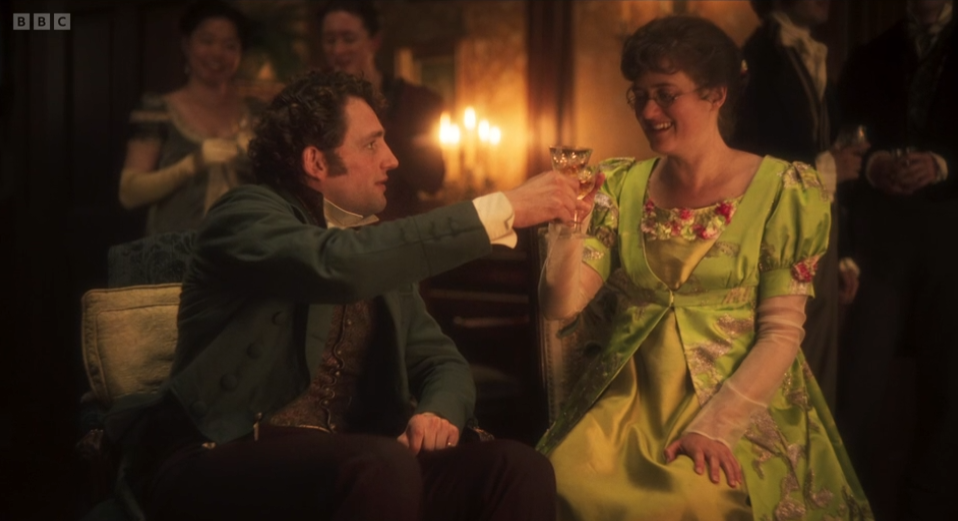
Mary wins! And the answer to the final riddle is heartache. Again, subtlety.
Anne congratulates Mary and is sorry to hear she’s leaving. Will, possibly having had a bit too much punch (but if he has, he seems to be a jolly drunk) tells her she can’t possibly leave, because games nights will be so dull.
As the guests leave, Aunt Gardiner tells her she’s caught the attention of the most eligible bachelor in town. Really? The most eligible? Is he a duke? I believe he’s eligible, and possibly the most eligible of their set, but the most eligible in all of London? Doubtful.
Mary tells her aunt she’d like to stay a little while, if she’s ok with that. Of course she is.
MayVO muses that, with a solid and constant application of basic kindness, one might change over time. I’m really glad she’s getting to experience that, honestly.


Comments