The Other Bennet Sister Episode 10 Recap

Tom has disappeared to parts unknown, and all of Mary’s attempts to contact him have hit a wall. This guy really wanted to get away, didn’t he?
Mary, now back in London, resolves not to wallow in the loss of Tom and instead decides to use her experiences to find her place and prove she could build a life in the metropolis.

What’s this? Mary stepping forth, independently, gathering strength and confidence? Time for her mother to come crawling out of her hole to ruin it!
Indeed, Mary walks into the drawing room at the Gardiners’ and finds the harridan sitting there, pinch-mouthed, and I don’t know why, but I immediately thought of Ursula from the Little Mermaid. Just this malevolent figure sitting there, ready to bring misery.

Aunt G, in a tone as dark as the mood in the room, tells Mary that Mrs B has come to stay. ‘For a short time,’ Uncle G adds, emphasising ‘short’. Ha!
Apparently, Lizzy’s physician suggested Mrs B come to London to see a specialist in nervous complaints. I’ll bet you anything Lizzy told the guy to do whatever it took to get her mother away from Pemberley for a while, and that specialist will basically just prescribe huge amounts of laudanum or something similar, and in this case, I’m ok with it.
Also, did Susan the paid companion quit? I'd be surprised if she lasted a week.
Mrs B graciously offers to help Mary find a husband one last time. Mary practically begs her not to, and Uncle G adds that Mary has plenty to occupy her already. He is clearly in no mood to put up with any of his sister’s nonsense.
Mrs B yammers on about her ‘natural kindness’ and ‘motherly instinct’ and the Gardiners exchange the BEST look in response to that.

Mrs B somehow arranges a bunch of blind dates for Mary (how? Some sort of Regency-era version of Bumble?) and of course they’re all terrible. I’d like to point out that, for all her bragging, she didn’t actually ‘find’ any of her other daughters’ husbands; in fact, she was more of a hindrance than anything else, especially when it came to Lizzy and Jane. (Maybe she found Kitty’s husband, we don’t know, but not the others.)
Mary gets harangued for not falling all over these awful men. Aunt G reassures her that she’s welcome to stay with them forever, so it’s not like there’s any kind of urgency for her to marry. Further discussion on the matter is interrupted by the arrival of William Ryder, who wants to see Mary.
He’s shown in, and I have to say, Aunt G seems a bit cool towards him. I don’t think she likes how he behaved up in the Lakes, and she’s not at all wrong to feel that way. She basically greets him with a more polite, ‘What’re you doing here?’

He and Mary repair to the drawing room, where he kind of apologises for leaving the Lakes so abruptly. He explains that he felt it was his duty to accompany Caroline back to London. Why? She had her sister and brother-in-law to look after her, and you’re not responsible for her in any way.
He reassures Mary he was kept informed of her recovery. And yet, he hasn’t come to see her until now, and I presume she’s been in London for a while, considering she’s had time to write and try to send several letters to Tom and was able to do all those dreadful dates.

He gets up and sincerely apologises for almost getting her killed. She reminds him that she, too, elected to stay up on that mountain but he insists that he was entirely to blame. Don’t go removing the lady’s agency, William.
She suggests they let this one go and says that, ending notwithstanding, she had a great time in the Lakes. That she did, until he arrived. He claims he never intended to intrude on her time there, which I 100% call BS on.
He goes on to explain that he had to talk to Tom because Lady Catherine de Bourgh has unexpectedly named William as her heir.
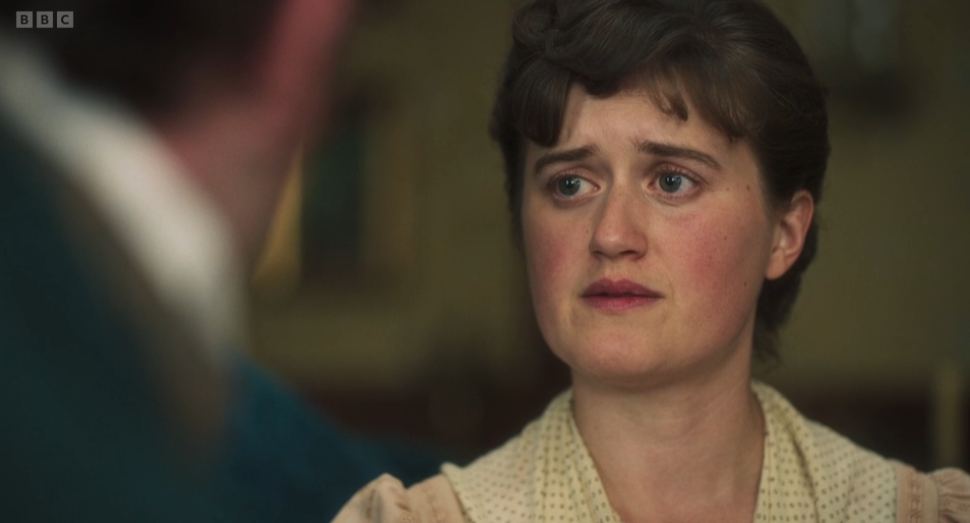
Whut? Did Anne de Bourgh die? Why wouldn’t Lady Catherine make her own daughter her heir? I thought Anne already was the heir? Wasn’t she referred to as the heiress to Rosings Park? Does Lady Catherine have a separate fortune she’s not bequeathing to her daughter for some reason? Why? This is so odd. I can’t figure out why they even used Lady Catherine from Pride and Prejudice instead of inventing a different character to fill this (unseen) role, especially since the connection to Darcy never gets mentioned. There’s no point, that I can see, in using Lady Catherine as a character here at all.
It’s not clear why he needed to involve Tom in this, but that feels like the least puzzling thing here.
William then drops the bombshell: he told Tom about his change in fortune, and about his (William’s) plan to propose to Mary that afternoon on Scafell Pike. See? I told you he absolutely meant to ‘intrude on her time’ there! And he told Tom this even after it was very clear that Tom was on the brink of proposing, and Mary was ready to accept? What a selfish dick this man is.
Tom realised that William could offer her so much more material stuff, so gave William his blessing. Excuse me? That was most definitely not his place, now, was it? Tom’s not her father or brother! He just handed her over? Like a toy William wanted? These men both suck. Mary, stay single!

William proposes, and Mary looks a bit sad but turns him down. Good call. This man just isn’t good husband material. He’s fun to hang out with, sure, but he’s also flighty and thoughtless and unreliable, and when things get tough, he will literally abandon you up a mountain. This is not the sort of person you want to be running a big estate with, or having a family with. These are serious, grown-up things, and he’s a child.
Her mother’s going to have a stroke, though. We hope.
She urges him to go to Italy, as he planned, and enjoy himself. He seems sad and disappointed but says he’s glad to see her looking so well.

He goes to leave and Mrs Bennet bursts in, having listened at the door the whole time. William just wants to get out of there and lick his wounds and Mary calmly tells her mother to chill and releases him. He bows his way right on out of there.
Mrs Bennet rounds on Mary, but Mary has no time for that and just leaves, saying she needs some air. Run, Mary, run!

She walks, instead, to the park and plunks down on a bench to mull over everything that’s happened that day. And then who should come along but Mr Sparrow! Oh, I wondered if we’d see him again, since he mentioned wanting to study medicine in London.
He sits on the bench beside her, cleans and checks her glasses for her, asks how she’s doing. We learn he graduated from Moorfields Eye Hospital recently; Mary congratulates him. He asks what she’s up to and she says she now hopes to be a governess to an older girl. (But she wasn’t good at governessing. I get that this was essentially the only career open to her, but it feels strange that she’s gone from being a reluctant and really bad governess to suddenly wanting to make a career of it. She got the kids to do some poetry once and now she loves teaching? I don’t buy it.)

She thinks this’ll be a chance for her to teach someone geology and other things that she’s interested in, because that’s what teaching is: forcing kids to follow your personal interests. Hopefully she’ll get super lucky and find a girl who wants to learn these things AND has parents who support what would, at the time, have been viewed as a very unusual curriculum for a young lady. That’s a unicorn student right there, but I guess it’s not like Mary’s desperate for a job, so she can look until she finds it.
Sparrow’s supportive, though, and mentions he has a daughter now. Wow, so quite a few years have passed since episode one, then? Unless he left Meryton soon after the assembly?

The conversation slides towards Mrs B, and how she won’t approve of Mary working for a living. Sparrow says that Mary and her mother tended to have rather different ideas about life. He points out that Mary’s always struggled to please her mother, so why keep trying? Why bash your head against that particular wall forever?
‘Our happiness is in our own hands,’ she says. Interesting how so many of Mary’s important life lessons have come from men in her life. With a sprinkling of Lizzy and Aunt G in there.

Sparrow wholeheartedly agrees with this sentiment and tells her it’s been great seeing her again, but he must be on his way, since he’s fulfilled his duty of dispensing a bit of wisdom just as it’s needed. We can’t have plot devices hanging about too long, they clutter up the place. It was nice to see him again, though. Glad he’s doing well.
Mary goes home and faces her mother, who is, predictably, in a nasty mood. But this is New Mary, who will not be calling William back or putting up with her mother’s particular brand of narcissistic BS anymore. Mrs B insists she’s trying to help Mary, because otherwise she’ll be looked down upon.
‘Looked down upon by whom?’ Mary asks coldly. She goes on to say that she doesn’t love William and hasn’t held out this long to marry someone she doesn’t love. Mrs Bennet reminds her that she was once willing to marry Collins, and she sure didn’t love him. Mary agrees, but says her approach to life and marriage has changed a bit since then. It’s called growth, madam, look into it.
Mrs Bennet demands to know what Mary will do without a husband to support her, and Mary floats her governess idea. Mrs B, of course, scoffs at that and screeches at her daughter for torturing her. Mary, may I recommend r/raisedbynarcissists? It might be a useful community for you.

Mary tells her mother that she’s always wanted to please her, and she’s sad she’s never been able to make her mother proud or to match her sisters in Mrs Bennet’s esteem. That’s such a sad couple of lines there. An entire lifetime of feeling unloved, lacking, unwanted. Nobody’s favourite, not even feeling particularly liked by her own sisters (as we learned in her scene with Lizzy). That’s a terrible way to exist.
Mrs Bennet, ever me-me-ME, snits that Mary has no idea what it’s been like for her. She had five daughters to marry off to men who could take care of them, and she had to do it all on her own, she had no help from their father. Poor you. If this is some effort to make her sympathetic in any way, it’s too little too late. She’s a repellent character, and I don’t pity her for this.
For one, raising the daughters to be good wives and helping to arrange advantageous marriages was, in large part, mum’s job anyway. Sure, there were areas where the husband could help (making the first introductions to eligible men, such as Mr Bingley, for example—which Mr Bennet DID) and setting money aside for dowries and such (which, it seems, he didn’t), but a lot of the work of getting daughters into society and married tended to be on the women, working within their network.
Second, as I mentioned earlier, her efforts didn’t really help much with at least three (probably all four) of her other daughters’ marriages. She was so embarrassing she spooked Darcy (who warned off Bingley), she didn’t court Wickham in any way, and she failed to control her youngest, who almost sank everyone’s chances of being able to show their faces in public again. She was terrible at her job, and her daughters married well despite her, not because of her.
Boo hoo, she weeps over how alone she was, battling this big bad world all by herself, with nothing but her poor nerves to keep her company. And Mary, right there, to act as her constant punching bag.
Mary shows more sympathy for her mother than I have, and tells her that, just because she isn’t following the conventional route doesn’t mean she’s a failure. She, like her sisters, is settled on a path, and she’s happy with that.
Mrs Bennet says she didn’t want Mary to be left behind. Mary just nods, realising that she and her mother will never agree and, as Sparrow said, she needs to stop trying to gain this woman’s impossible approval.
Mrs Bennet gets her stuff and leaves, to the likely joy of the Gardiners and, I’m sure, the absolute despair of all the residents of Pemberley. Jane, Bingley, it’s your turn to take the wicked witch in for a while.

Mary and Mrs G take a walk in a park and Mary admits she’s not sorry she’ll never marry, but she is sorry she’ll never have a home of her own and won’t get to choose her own wallpaper. They laugh and Mrs G tells her she can choose the wallpaper for her room any time she likes.
Mary asks her aunt if she thinks Mary’s done the wrong thing, turning William down. Aunt G’s like, ‘Girl, no!’ Mary says she’s learned a lot about finding joy in life from him, which is nice and all, but not necessarily the foundation for a stable marriage. Especially if you don’t love the man.
They return home and find Caroline waiting for Mary in the drawing room.
Caroline acts kind of twitchy, and finally manages to thank Mary for helping her down the mountain instead of just abandoning her, which I guess Caroline thinks was a valid option? Guess we know what Caroline would have done if Mary had been the one stuck.

Caroline goes on to say that she has a great fondness for William, and I find myself wondering why that is. They don’t seem to have particularly compatible personalities. She’s chilly and uptight and he’s… the opposite of that. It seems like he would annoy her more than anything. I could understand if she wanted to marry him because he’s young and rich and handsome, but I wouldn’t have expected much in the way of tender feelings to come into it, not from her side, at least. Maybe they have the Wordsworth stuff in common? But I figured she was just putting that on to impress him; we know from Pride and Prejudice that she was more of a performative reader. I don’t buy this. They could have just as easily had Caroline come and say she’s getting a bit late in years (by the standards of the time) and needs to marry to maintain any sort of social position similar to what she has now. It makes more sense for the character and sets up another contrast with Mary’s determination that love should have at least something to do with it.

But, whatever, Caroline’s in love with William or something and has come to ask Mary to back off. Mary’s like, ‘With all my heart, you can have him. I’m in love with Tom. Shame he’s disappeared.’ You can practically see the gears start to turn in Caroline’s head.
She goes to leave and they have the most hilariously awkward parting. Caroline, with some difficulty, suggests she might call for Mary sometime. (Something she should have been doing anyway, since they’re relatives by marriage and there were rules around this sort of thing.) Mary gets unexpectedly enthusiastic and suggests they could read poetry together. Caroline looks terrified by the very idea (see: I don’t think she’s actually all that into poetry!) and leaves.

Within the week, Mary’s scored that unicorn governess job she wanted, with a girl who looks to be around 14 or so. She’s still hanging out with Anne Baxter, loving life with the Gardiners, and just generally being happy. She’s still trying to make that horrible green dress work, bless her.

While out in the park (once more wearing that amazing blue checked dress and magenta spencer from the day she climbed Scafell), her reverie is interrupted by someone shouting her name. Why, it’s Tom! Of course it’s Tom.

They approach each other slowly and meet near a fountain. And then she sharply asks where the heck he’s been all this time. Quite right! Don’t let him off the hook here, Mary!
He’s been in Yorkshire (where, I’m guessing, he’s from, given the northern accent).

‘You cannot say Yorkshire as if that’s a reasonable explanation for your very sudden and very lengthy disappearance,’ she tells him.
He tells her he’s sorry and she decides to stop being mad and let him speak his piece.
He explains what we already know: about William being set to inherit a fortune (presumably another one, because he sure didn’t seem poor before), and how obvious it was that William had ‘a liking’ for Mary. Tom, too, had (has!) ‘a liking’ for Mary. Such a strong liking, in fact, that when he heard William could give her a more luxurious life, he thought it best to just let the other guy have her.

‘You thought it in my best interest to graciously step aside?’ Mary repeats, disbelievingly. Yes, Mary! Hold him to account! This is BAD, this is VERY BAD. Apparently at no point did either of these men think it was in your best interest to let you, an adult woman, make this choice for herself. They were two boys fighting over a toy. Gross, Tom!
‘So, your disappearance was, in fact, you being gracious to me?’ she says, and Tom starts to realise just how utterly stupid all of this sounds.
She whallops him on the arm, twice, which is not the best way to start a relationship. I get that she’s mad, but physical violence isn’t cool, Mary.
She asks why he didn’t just ask her what she thought and how she felt and he said he was basically just assuming. That all she cares about is material wealth? You don’t know her well at all, do you, Tom? Although, she did say that weird thing about Lizzy and Pemberley.

He says he’s here to ask her what she wants. Better late than never, right? He knows he can’t offer her what William can (lots of money, and Italy), but he can offer her all the love and that’s really what she wants anyway. And, I think, deep down she’d rather have the kind of stability that Tom offers too. Can you imagine having a young family with someone like William, who’d probably wake up on any given day and say, ‘I’m bored of Italy, let’s hit up Russia for a while!’ Someone with a steady job, who’s had to work for everything he has, is a much better long-term prospect unless you really love the nomad life, and I’m not sure Mary would.

Mary tells Tom that she never loved William, she always loved Tom. He gets all excited, ‘I love you too!’ Aww. I’m still a little mad at him, though. But I guess this sort of misogyny is to be expected in 1814. (I’m assuming it’s still 1814?)
They’re very happy. It’s cute. He blurts out a proposal, probably worried William’s going to pop up and interrupt again, and I wouldn’t put it past that guy. Mary accepts, of course. They kiss, they’re giggly and giddy, it’s super sweet. Tom looks unbelievably relieved.

Mary has a, ‘hang on a second’ moment and asks what made him come back. He was somehow tracked down and summoned back by Caroline Bingley herself, who’s now rushed off to Italy in pursuit of Ryder.
(How would he know that? How would Mary not know that Caroline has left London, I’d think that sort of thing would have been remarked upon—a young, unmarried woman running after a man? In Italy? While the Continent was still reorganising itself in the wake of the Napoleonic wars and abdication? That would have been serious gossip fodder, and let’s not forget, Mary’s sister is married to Caroline’s brother! Word would’ve gotten round, is what I’m saying. These family networks were no joke.)

Reader, she married him. The Gardiners celebrate adorably, as only the Gardiners can (with Graces ribbons!). They move into a home of their own, where Mary writes a letter to Hill, acknowledging that the woman was right, Mary did need to leave and see the world outside her own family.
(Fun fact: the actress who plays Hill also played Mary Bennet in the 1995 Pride and Prejudice miniseries! That’s the kind of stunt casting I can get behind!)
Mary has apparently chosen her own wallpaper and… it’s a choice, I’ll say that. Her dress is pretty, though.

The happy couple are happy and couple-y. The camera finishes by zooming in on a manuscript sitting on the desk: Advice for a Young Woman, by Mary Bennet. They really missed a trick by not having that be First Impressions, didn’t they? Too similar to the Little Women ending?

And that’s that for The Other Bennet Sister! I must admit, I had trouble settling into this at the beginning, but then it grew on me. It had its weaknesses, but Ella Bruccoleri was so good, as were many members of the supporting cast. And although the costumes got a bit hit or miss, the lighting and cinematography were gorgeous. You can see it from a lot of the still shots, just so beautifully lit, so rich, and interesting. A visual feast!
Stray thoughts:
The hair and makeup people really wanted us to hate Ruth Jones, didn’t they? The way she was styled was so unflattering and harsh, it was off-putting just to look at her. She's such a beautiful woman in real life! (And she was hands down my favourite part of Gavin and Stacey.) I wish she’d had a better role here, I really do.
Speaking of Mrs Bennet: I liked that they always had her in a floral pattern. Those nice, delicate, feminine patterns made an interesting contrast with her actual personality.
Also: I think Charlotte aways wears green, which I feel must have been deliberate. Indicating her jealous nature, perhaps? Her envy of Mary? Discuss!
The eye acting in some of these episodes was next level. Special shout-outs to the actresses playing Lizzy and Jane, and the actor who played Collins. Splendid.
Was Collins possibly being posited as being on the spectrum? I noted in my recap that the way he twitched and picked at surfaces was almost like a stim. That must have been so hard for people at that time, before there was any real diagnosis or understanding (it’s hard enough now!). They did a decent job of giving him a bit of dimension, and I appreciate that. I don’t mind secondary characters getting a bit more fleshed out (but I do mind them being transformed into completely different people for no reason).
I haven’t been able to find any primrose lore about someone eating one and being the first to marry, so I’m convinced the guide just made that up in the hope someone would do exactly what Caroline did. I’ll bet he had a lot of laughs over the dumb toffs he took up the mountain that day.
Do you think Caroline and William will make it? I give the marriage a couple of years, tops, if they even get that far. She’ll go back to England, he’ll hook up with Byron and the Shelleys or whatever and they’ll just live separate lives.


Comments